Khoj
Turns your documents and the web into a searchable, chat-based personal AI assistant
Khoj is an open-source AI copilot designed to enhance the way individuals manage and interact with information. In that sense, it simplifies the process of obtaining answers and insights by combining the power of AI with a user’s personal knowledge base.
Users can easily merge data from various sources such as PDFs, markdown files, plaintext documents, GitHub, and Notion — allowing Khoj to provide precise and relevant information without manually sifting through search results or personal notes. The platform also supports internet searches, so that users can find the latest information online without switching between tabs or devices.
Furthermore, Khoj supports hands-free operation through text-to-speech, allowing users to interact with the tool using their voice in their native language.
With a native desktop app availability across operating systems, and support for first-party clients like Emacs, Obsidian, or WhatsApp – the tool is accessible wherever its users happen to be. Plus, it is completely open-source, providing the flexibility to customize and self-host Khoj on personal machines for privacy and tailored use.
In addition, it invites users to suggest new features and improvements, emphasizing accessibility, security, and transparency in personal AI assistance.
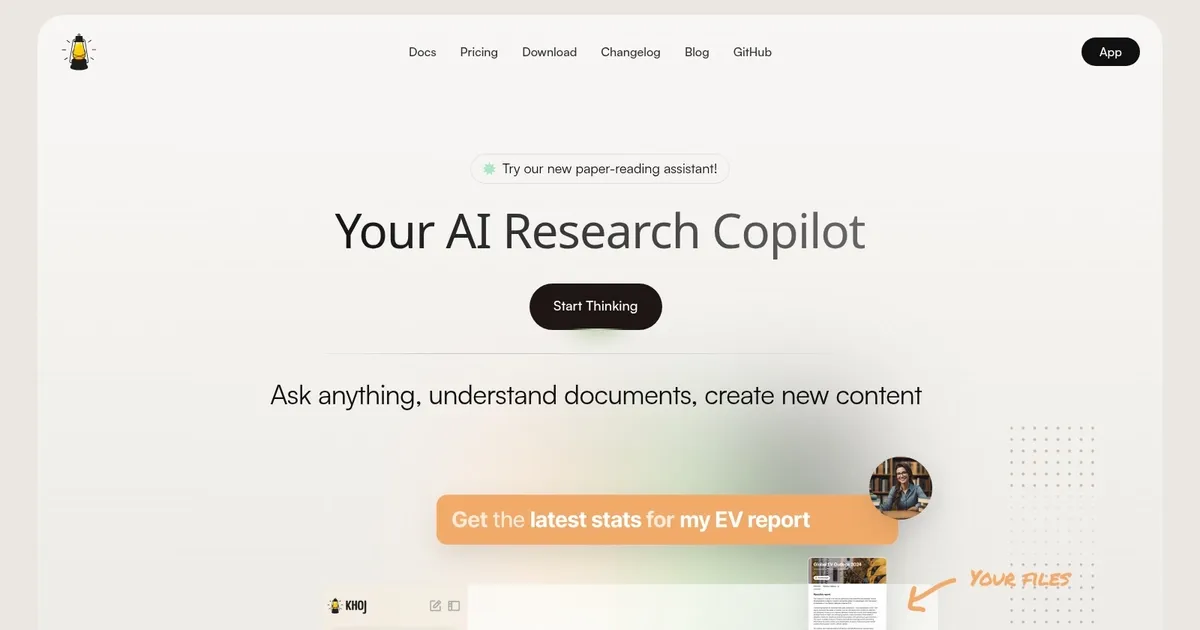
Homepage Screenshot 📸
What are the key features? ✨
- Semantic Search: Finds relevant information across your personal documents and the web using meaning, not just keywords.
- Chat with Notes: Converses naturally with your files (PDFs, images, markdown, org-mode) for answers, summaries, or content creation.
- Custom Agents: Build personalized AI agents with specific knowledge, personas, and tools for automation and tasks.
- Multi-LLM Support: Connects to local models (Llama, Mistral) or online ones (GPT, Claude, Gemini) for flexibility and privacy.
- Integrations: Works seamlessly in Obsidian, Emacs, browser, desktop, mobile, and WhatsApp.
Who is it for? 🤔
Examples of what you can use it for 💡
- Researcher: Queries years of accumulated papers, notes and web sources to generate literature summaries or find forgotten references quickly.
- Writer: Chats with draft notes and research files to brainstorm ideas, outline articles or rephrase sections while keeping everything private.
- Obsidian User: Uses the side-pane integration to ask questions about vault contents, automate weekly note reviews or surface connections between ideas.
- Freelancer: Builds agents to monitor industry news, summarize client documents and send automated status reports without manual effort.
- Student: Indexes lecture notes, textbooks (PDFs) and images to answer study questions offline or prepare exam outlines from personal materials.
Pros & Cons ⚖️
- Strong privacy via self-hosting
- Deep personal file integration
- Custom agents and automation
- Multi-platform access
- Local models can be slow
- Setup effort for self-host
FAQs 💬
Ready to try Khoj?
Turns your documents and the web into a searchable, chat-based personal AI assistant
Visit KhojKhoj alternatives 🔗