Langbase
Builds serverless AI agents with memory and tools
Langbase is a serverless platform for developers to build, deploy, and scale AI agents with memory and tools. It provides unified APIs for over 250 LLMs, including OpenAI, Anthropic, and Google models. Core components include Pipes for composable agents, Memory for RAG with semantic chunking, and Tools for function calling and web access.
Pipes function as serverless agents that integrate memory and tools. Users configure prompts, models, and parameters via JSON. Deployment yields Generate and Chat APIs with unique keys. Versioning tracks four types: config changes, prompt updates, model swaps, and tool additions. Open Pipes enable public sharing with CDN caching for zero inference cost.
Memory handles vector storage and retrieval. It processes files like PDFs and spreadsheets into chunks, embeds them, and retrieves relevant context for queries. Parameters include chunk max length (1024-30000 characters) and overlap (minimum 256). Retrieval testing verifies data quality without LLM calls. This reduces hallucinations by 97 percent and costs 50-100 times less than alternatives.
Studio offers no-code exploration with analytics, experiments, and LangUI for custom chat interfaces. Experiments run new configs against past completions for evaluation. Keysets store LLM keys with RBAC at org, user, or pipe levels. Usage tracking provides LLMOps logs and traces, yielding 60-90 percent cost savings.
Competitors include LlamaIndex for indexing and querying, which requires more custom code but offers deeper retrieval options. Langbase pricing starts free with 500 credits and scales to paid plans around 100 dollars monthly for individuals, providing unlimited pipes and more memory in higher tiers. Users benefit from rapid prototyping and collaboration. For implementation, configure a Pipe, add Memory, test retrieval, and deploy via SDK in TypeScript or Python.
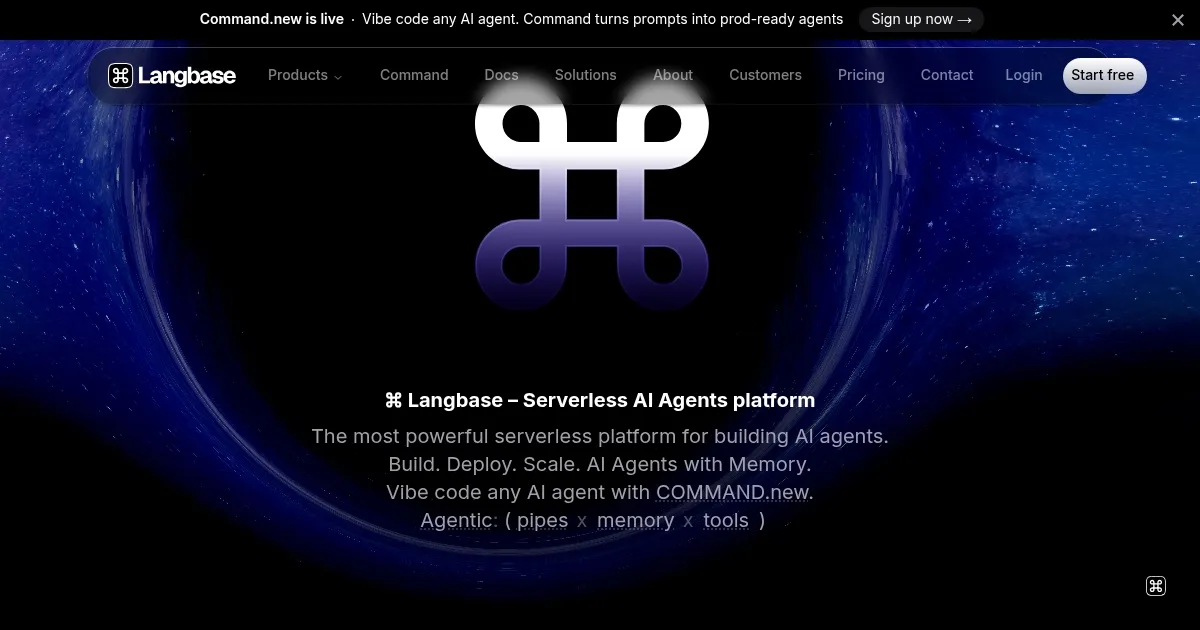
Homepage Screenshot 📸
Video Overview 🎬
What are the key features? ✨
- Pipes: Serverless agents that compose like components for building multi-step AI workflows.
- Memory: Zero-config RAG for accurate retrieval from files and vectors with semantic chunking.
- Unified API: Single interface for 250+ LLMs to switch models without code changes.
- Studio: No-code environment for experimenting, analytics, and real-time collaboration on agents.
- Tools: Function calling and integrations like web search for agent actions and structured outputs.
Who is it for? 🤔
Examples of what you can use it for 💡
- Software Developer: Creates a RAG agent to query internal docs, using Memory to chunk PDFs and retrieve guidelines accurately.
- Product Manager: Deploys LangUI chatbot for customer support, integrating Pipes with tools for real-time query resolution.
- AI Researcher: Runs experiments in Studio to eval LLM configs against past runs, optimizing for lower hallucinations.
- Startup Founder: Forks open Pipes for quick MVP, versioning prompts to iterate on user feedback loops.
- DevOps Engineer: Manages keysets with RBAC to secure LLM access across org pipes, tracking costs via analytics.
Pros & Cons ⚖️
- Easy prototyping
- Cost savings 60-90%
- Unified LLM API
- Strong collab tools
- Free tier limits
- JS focused SDK
FAQs 💬