logo-darklogo-darklogo-darklogo-dark
  • Tool Categories
    • 🎨Art & Creative Design505
    • 🏢Business Management644
    • 💻Coding & Development515
    • 👮Detection83
    • 🧠General Use727
    • 🏥Health & Wellness55
    • 📷Image & Photo Analysis100
    • 🖼️Image Generation & Editing618
    • 📐Interior & Architectural Design37
    • 🎓Learning & Education483
    • ⚖️Legal & Finance90
    • 🎭Lifestyle & Entertainment236
    • 📢Marketing & Advertising627
    • 🎧Music & Audio138
    • 👔Office & Workplace1,014
    • 🔬Research & Data Analysis372
    • 👥Social Media245
    • 🎥Video Generation & Editing426
    • 👧🏻Virtual Companion135
    • 🎤Voice Generation & Editing381
    • ✍️Writing & Editing808
    • All Categories
    • AI Use Cases
  • News
  • Events
    • Academic Conferences
    • Developer Conferences
    • Expos / Trade Shows
    • Industry Summits
    • Workshops / Training
    • All Events
    • Past Events
  • Saved Tools
  • Suggest a Tool
✕
Home › Voice Generation & Editing › Speech Recognition› Wit.ai
Wit.ai

Wit.ai by Meta

Turns speech and text into structured data for apps

Wit.ai is a free, open-source natural language processing platform that enables developers to build conversational interfaces by converting speech and text into structured data. Acquired by Meta in 2015, it supports applications like chatbots and voice assistants. Developers use its web console to train models, defining intents and entities to interpret user input. It supports multiple languages and integrates with various platforms via APIs and SDKs.

The platform’s core features include intent detection, entity recognition, and context management. Intent detection identifies what users want, like “order food” in a query. Entity recognition extracts details, such as “pizza” or “New York,” while context management tracks conversation history for coherent responses. Wit.ai provides SDKs for Node.js, Python, and Ruby, among others, and its RESTful API allows integration with web, mobile, and IoT devices. The platform learns from user interactions, improving over time with more training data.

Compared to Dialogflow and Amazon Lex, Wit.ai is notable for its free access. Dialogflow offers similar NLP capabilities but restricts some features to paid plans. Amazon Lex integrates tightly with AWS, which may limit flexibility for non-AWS users. Wit.ai’s open-source libraries and active community provide robust support, though its documentation can be dense for beginners.

Users may appreciate the free pricing and ease of integration. The ability to create custom entities offers flexibility, and multilingual support broadens its appeal. However, training the model requires significant effort to achieve accuracy, especially for complex queries. Some developers express concerns about data privacy due to Meta’s ownership, as noted in recent X posts. The platform may struggle with nuanced or ambiguous inputs without extensive training.

To use Wit.ai effectively, begin with simple intents and entities. Use the official documentation for setup guidance and test with varied inputs to refine performance. Join community forums for practical advice and monitor privacy considerations for your project.

Visit Wit.ai ↗
Categories
🎤 Voice
🗣️ Speech Recognition 💬 Speech-to-Text 🤖 Voice Assistant 🔠 Audio To Text
💻 Coding
👨‍💻 Development
🧠 General
💬 Chatbot 🧠 Large Language Model

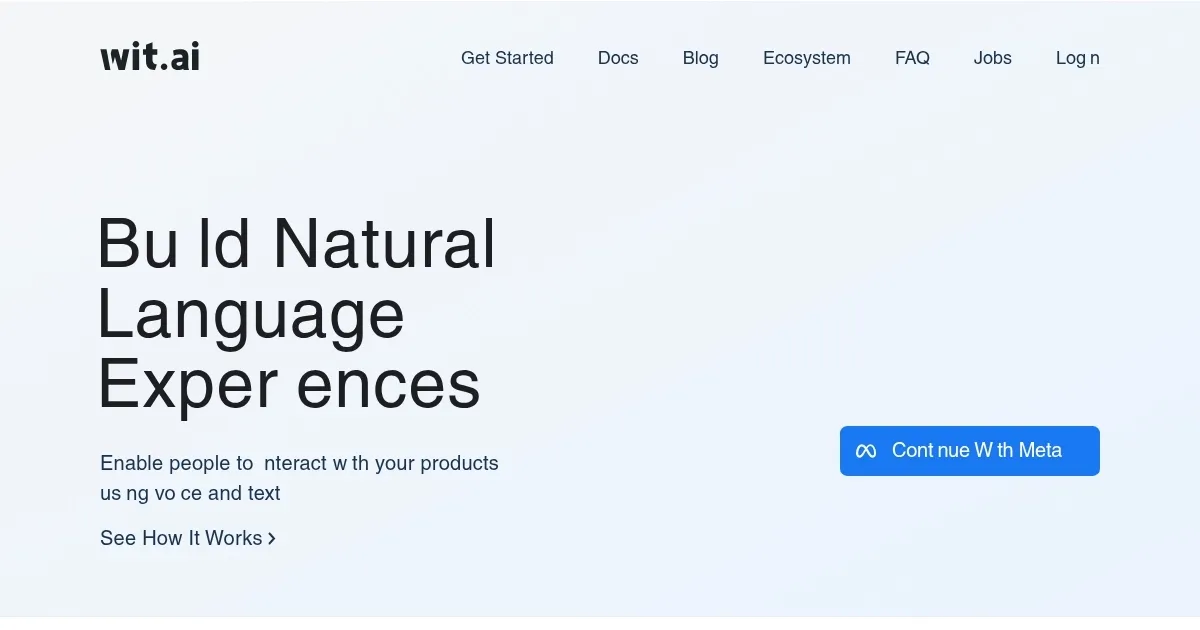
Homepage Screenshot 📸

Wit.ai screenshot

Video Overview 🎬

What are the key features? ✨

  • Speech Recognition: Converts spoken language into text for voice-driven apps.
  • Intent Detection: Identifies user goals, like “book a flight,” from input.
  • Entity Recognition: Extracts specific details, such as locations or names, from text.
  • Context Management: Tracks conversation history for coherent responses.
  • Multilingual Support: Processes multiple languages for broader accessibility.

Who is it for? 🤔

Wit.ai is made for developers, startups, and small businesses looking to build conversational interfaces like chatbots or voice assistants without high costs. It suits those comfortable with APIs and willing to invest time in training models, from indie coders creating mobile apps to teams developing IoT solutions. Its free pricing and open-source nature make it accessible for budget-conscious projects, while its flexibility appeals to those targeting multilingual or cross-platform applications.

Examples of what you can use it for 💡

  • Mobile App Developer: Builds a chatbot to handle user queries in a travel app.
  • Smart Home Engineer: Integrates voice control for devices like thermostats.
  • E-commerce Owner: Creates a conversational interface for product searches.
  • Healthcare Startup: Develops a voice assistant for patient scheduling.
  • Customer Service Manager: Automates responses to common client inquiries.

Pros & Cons ⚖️

  • Free to use for all features.
  • Supports multiple languages.
  • Easy integration with APIs.
  • Steep learning curve for beginners.
  • Requires extensive training data.

FAQs 💬
What is Wit.ai used for?
Wit.ai helps developers build apps that understand and respond to human speech or text.
Is Wit.ai free to use?
Yes, Wit.ai is completely free with no paid tiers required for full access.
What platforms does Wit.ai support?
It integrates with web, mobile, and IoT devices via APIs and SDKs.
Does Wit.ai support multiple languages?
Yes, it processes various languages, making it suitable for global applications.
How do I start using Wit.ai?
Sign up on the Wit.ai website and create an app to begin training it.
What are Wit.ai’s main competitors?
Dialogflow and Amazon Lex are key competitors with similar NLP capabilities.
Do I need coding skills to use Wit.ai?
Basic coding knowledge is needed to integrate and train the platform.
Can Wit.ai handle complex conversations?
It can with sufficient training, though it may struggle with nuanced inputs.
Is Wit.ai’s data secure?
Meta’s ownership raises privacy concerns, so review terms before use.
Where can I find help with Wit.ai?
Official documentation and community forums offer extensive support.

Ready to try Wit.ai?

Turns speech and text into structured data for apps

Visit Wit.ai ↗

Wit.ai alternatives 🔗

  1. TurboScribe TurboScribe Transcribes audio and video files to accurate text instantly
  2. Otter.ai Otter.ai An AI meeting assistant that writes notes, captures slides and more
  3. Memrise Memrise An AI-powered platform offering efficient and engaging methods for users to learn new languages
  4. TalkPal TalkPal The most efficient way to learn a language, powered by GPT
  5. Flow Flow An AI-powered tool that transcribes speech into text with speed and accuracy
  6. Speechnotes Speechnotes Web-based transcription tool offering a simple and efficient way to convert speech into text
Share
Wit.ai screenshot enlarged
Promote Wit.ai
light badge
Copy Embed Code
dark badge
Copy Embed Code
neutral badge
Copy Embed Code
Best AI Tools

Discover the best AI tools for any use case

Explore
  • Tool Categories
  • AI Use Cases
  • AI Events
  • AI News
  • Saved Tools
Company
  • About Us
  • Contact Us
  • Media & Partnerships
  • Suggest a Tool
Legal
  • Privacy Policy
  • Terms of Service
Copyright © 2026 Best AI Tools 415 Mission Street, 37th Floor, San Francisco, CA 94105