Haystack by deepset
Orchestrates customizable, production-ready LLM applications
Haystack is an open-source AI framework by deepset for building production-ready LLM applications, including RAG pipelines, AI agents, and scalable search systems. It uses modular components and pipelines to connect LLMs, vector databases, and tools, enabling developers to create tailored solutions. Key features include the Agent component for reasoning and tool use, support for integrations with OpenAI, Anthropic, and databases like Weaviate, and deepset Studio for visual pipeline design. The framework supports Python developers with clear documentation and a strong community on Discord and GitHub.
The pipeline system allows flexible configurations, supporting simultaneous data flows, branching, and loops for complex tasks like agentic workflows. For example, the SerperDevWebSearch tool enables agents to fetch real-time data, while serialization ensures pipelines are portable for cloud or on-premise deployment. Haystack’s explicit component connections simplify debugging, and its AsyncPipeline boosts performance by running independent tasks concurrently. Recent updates, like Haystack 2.0, enhance modularity and integration options.
Compared to LangChain, Haystack offers clearer pipeline structures and production-focused features, while LlamaIndex specializes in RAG but lacks Haystack’s agentic capabilities. Users on Reddit praise Haystack’s flexibility but note a steep learning curve for beginners. Some report challenges with less common database integrations, requiring custom tweaks.
The open-source version is free, making it accessible for developers, while Haystack Enterprise provides premium support and templates, likely at a higher cost. Deepset Studio is a free visual tool, easing prototyping. The framework’s modularity suits scaling but may overwhelm novices.
Start with the “Get Started” guide, test a basic RAG pipeline, and explore tutorials for advanced features like tool-calling agents. Join the Discord community for support, and use deepset Studio to visualize your workflows before coding.
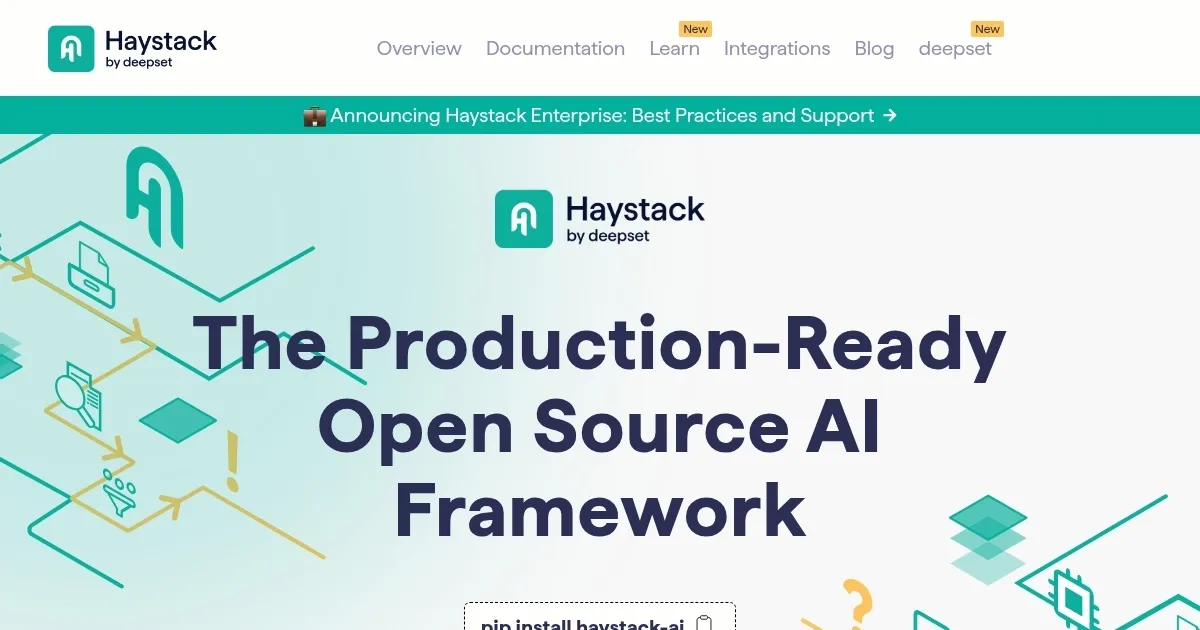
Homepage Screenshot 📸
Video Overview 🎬
What are the key features? ✨
- Agent Component: Enables reasoning and tool use for dynamic AI agents.
- Pipeline System: Connects modular components for flexible workflows.
- Deepset Studio: Offers a free drag-and-drop interface for pipeline design.
- Integrations: Supports OpenAI, Anthropic, Weaviate, and more.
- Serialization: Saves pipelines for easy deployment across environments.
Who is it for? 🤔
Examples of what you can use it for 💡
- AI Developer: Builds a RAG pipeline to query large document sets.
- Data Scientist: Creates a semantic search system for research data.
- Enterprise Team: Deploys a multi-agent system for customer support.
- Startup Founder: Prototypes a chatbot using deepset Studio’s visual editor.
- ML Engineer: Integrates custom components for specialized workflows.
Pros & Cons ⚖️
- Flexible pipeline design
- Strong community support
- Free deepset Studio
- Broad model integrations
- Steep learning curve
- Complex setup for beginners
FAQs 💬