Mem0
Enhances AI agents with persistent, adaptive memory for personalized interactions
Mem0 is a memory layer for AI applications, enabling persistent, personalized interactions by storing and recalling user context across sessions. It addresses the stateless nature of LLMs, which typically forget interactions after each session, by using a hybrid datastore combining key-value, graph, and vector stores. This architecture supports quick fact retrieval, relationship mapping, and semantic context, making AI agents more efficient and user-focused. Founded in 2023 by Taranjeet Singh and Deshraj Yadav, Mem0 is backed by Y Combinator and serves developers and enterprises building personalized AI solutions.
The tool offers a two-phase pipeline: extraction and update. During extraction, Mem0 uses LLMs to identify key facts and relationships from conversations. The update phase ensures memories stay relevant by resolving conflicts or redundancies. It supports short-term, long-term, and episodic memory, mimicking human cognition. Mem0 integrates with platforms like OpenAI, Claude, and Azure AI, with a single-line setup for Python or JavaScript. Benchmarks show it outperforms OpenAI’s memory by 26% in accuracy and reduces latency by 91% compared to full-context methods.
Pricing includes a free tier for developers, with Pro and Enterprise plans for teams needing scalability and compliance (SOC 2, HIPAA). Compared to LangChain or LlamaIndex, Mem0 focuses specifically on memory, not general RAG, making it leaner for personalization tasks. Pinecone excels in vector search but lacks Mem0’s graph-based relational capabilities. User feedback highlights easy integration but notes occasional complexity in customizing memory filters.
Mem0’s OpenMemory MCP extension allows cross-platform memory sharing, enhancing tools like ChatGPT and Claude. Case studies report significant wins: BrowserUse achieved 98% task completion, and Sunflower Sober scaled to 80,000 users with tailored support. The open-source SDK offers flexibility, while the managed platform ensures enterprise-grade security. Some users report latency issues with complex queries, and non-developers may find setup challenging.
For implementation, explore the GitHub repo for code samples and start with the free tier to test compatibility with your LLM stack. Focus on defining clear memory categories to maximize efficiency.
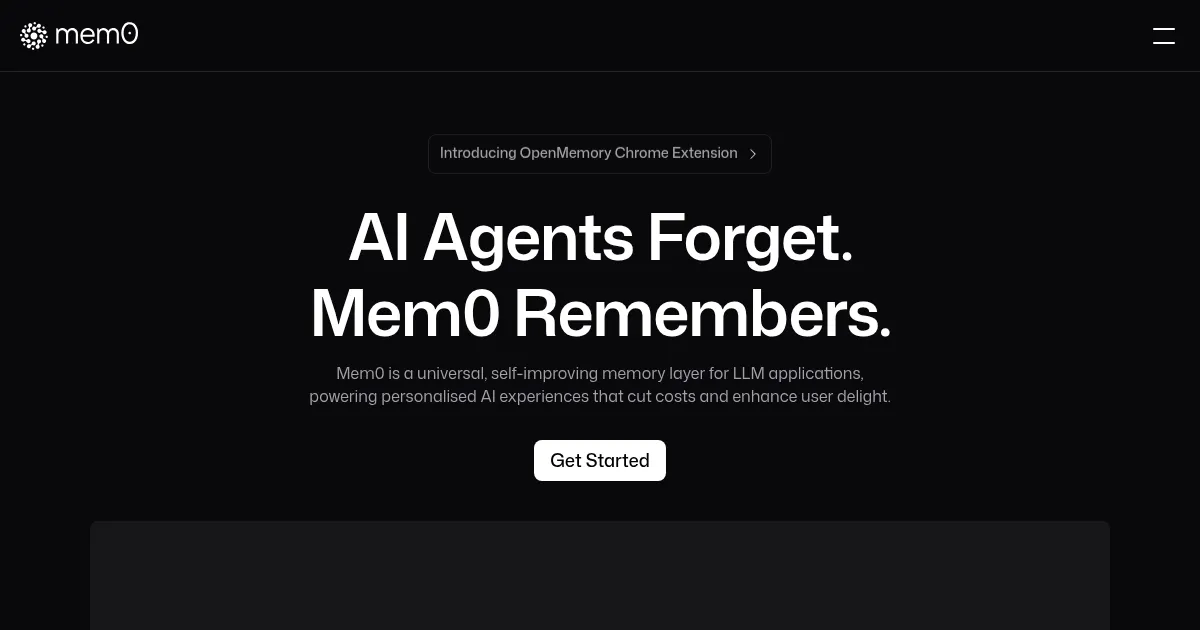
Homepage Screenshot 📸
Video Overview 🎬
What are the key features? ✨
- Intelligent Memory Retention: Stores user context for personalized AI responses.
- Hybrid Datastore: Combines key-value, graph, and vector stores for efficient memory management.
- Cost Optimization: Reduces LLM costs by up to 80% through smart data filtering.
- Seamless Integration: Supports OpenAI, Claude, and more with single-line setup.
- OpenMemory MCP: Syncs memories across AI tools like ChatGPT and Claude.
Who is it for? 🤔
Examples of what you can use it for 💡
- Customer Support Agent: Stores user issues and preferences for consistent, tailored responses.
- Educational AI Tutor: Tracks student progress and learning styles for personalized lessons.
- Travel Planning Assistant: Remembers user travel preferences for customized itineraries.
- Healthcare Chatbot: Recalls patient history for context-aware health advice.
- Personal Productivity Bot: Saves user goals and habits for relevant task suggestions.
Pros & Cons ⚖️
- Enhances AI personalization
- Reduces LLM costs significantly
- Open-source and enterprise options
- Occasional latency spikes
- Limited niche LLM support
FAQs 💬
Ready to try Mem0?
Enhances AI agents with persistent, adaptive memory for personalized interactions
Visit Mem0Mem0 alternatives 🔗