Parsio
Automates data extraction from emails and PDFs using AI parsers
Parsio is an AI-powered platform that extracts structured data from emails, PDFs, and attachments using OCR, template-based parsing, and GPT models. It processes documents in seconds via a no-code interface, supporting file types like PDF, XLSX, DOCX, CSV, and XML. The PDF parser handles invoices, receipts, business cards, and ID documents with pre-built AI models, including table extraction for variable rows and multi-language recognition for Latin and European scripts, both printed and handwritten. Email parsing captures subject, body, attachments, and signatures in real time, with custom formatting and business logic applied before export. Integrations connect to over 6,000 apps via Zapier and Make, plus direct links to Google Sheets, Slack, QuickBooks, and Google Drive for automated workflows.
Key features include the Airparser for GPT-powered handling of unstructured content, Chrome Signature Parser for contact extraction, and API/webhook support for custom setups. Pricing offers a free Sandbox plan with 30 parses and 30-day retention, followed by Starter at 1,000 parses monthly, Growth at 5,000, and Business at 12,000 with dedicated support and longer retention, all including unlimited mailboxes and post-processing. Compared to Docparser, Parsio adds email and attachment parsing absent in Docparsers zonal OCR focus, which requires more templates for layouts but suits simple forms at similar entry costs. Affinda emphasizes API-driven extraction for developers, with stronger resume and invoice specifics, yet Parsio provides broader no-code access at lower scaling rates. Klippa includes fraud detection for financial docs, outperforming in compliance but lacking Parsios email depth, with comparable plan structures.
Users report 100 percent accuracy on clean documents, reducing manual entry errors, though scanned files under 95 percent require retries. Capterra reviews note easy template creation by text highlighting, saving setup time to minutes, but highlight limits on free parses and occasional multilingual gaps. Product Hunt feedback praises real-time Slack notifications for leads, while G2 users value QuickBooks sync for accounts payable, citing fewer overloads during peaks. Reddit discussions favor Parsio over self-hosted options for ease, though some seek alternatives for unlimited volumes. Technical specs include GDPR compliance, EU data storage, SSL transmission, and scalability for thousands of monthly files without performance drops.
The platform runs on hybrid engines: template for fixed layouts, AI for common docs, and GPT for complex cases, enabling 99 percent uptime in high-volume tests. Exports format as JSON, CSV, or direct app pushes, with rules for data normalization like date standardization. Drawbacks include no native redaction for sensitive fields and mobile dashboard lag, per user logs. It processes up to 12,000 items monthly on top tiers, with annual discounts around 17 percent. For implementation, test with the Sandbox by forwarding sample emails, build one template per doc type, then integrate via Zapier for exports; monitor first 50 parses for accuracy tweaks before full rollout.
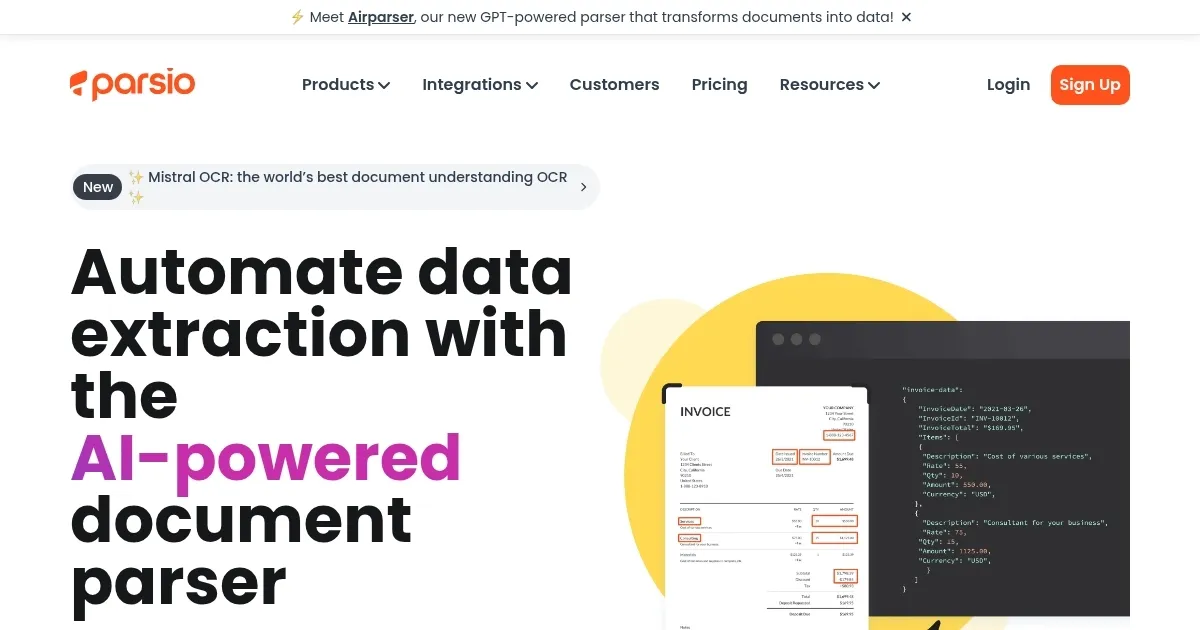
Homepage Screenshot 📸
Video Overview 🎬
What are the key features? ✨
- AI-Powered PDF Parser: Uses OCR and pre-trained models to extract data from invoices, receipts, and scanned images in seconds, supporting handwritten text.
- Email and Attachment Parser: Captures structured data from email bodies, subjects, and attachments like XLSX or DOCX, with real-time processing.
- Table Extraction: Automatically identifies and pulls variable rows from tables in PDFs or emails, simplifying repetitive data handling.
- GPT-Powered Airparser: Handles unstructured documents and complex formats using advanced language models for higher accuracy on irregular content.
- Integrations and Exports: Connects to 6,000+ apps via Zapier, with direct syncs to Google Sheets, Slack, and QuickBooks for automated workflows.
Who is it for? 🤔
Examples of what you can use it for 💡
- Sales Manager: Parses incoming lead emails from HARO or LinkedIn, extracts contacts and details, then syncs to CRM for follow-up nurturing.
- Accountant: Extracts line items and totals from PDF invoices and receipts, formats them, and imports directly to QuickBooks for payable automation.
- Freelancer: Pulls client info from business card photos or email signatures, organizes into Google Sheets for quick invoicing and tracking.
- Real Estate Agent: Processes ID documents and contracts via OCR, verifies data in real time, and uploads to Google Drive for compliance storage.
- Marketing Agency: Handles attachment-heavy campaign responses, extracts metrics from XLSX files, and notifies team via Slack for analysis.
Pros & Cons ⚖️
- High accuracy on scans
- Easy integrations
- Multi-language support
- Free tier limits
- Scan quality issues
FAQs 💬